Tuesday, September 12, 2017

Starting the Marathon with a Sprint


Full disclosure – I know next to nothing about running.  I am not, nor have I ever been, a runner.  While my daughter was on the track and field team in high school, she pursued pole vaulting.  Sitting in the required annual meeting for parents of pole vaulters while they describe the possible injuries and/or death possible from this sport is a whole other level of parental hell, but it sheds no light on running.  Yet, despite all of my lack of knowledge of the sport, even I know that you should not start a marathon by sprinting. 


But each year that seems to be exactly what teachers do.  Ask a teacher to describe how they are feeling right before the kids come back and you are sure to hear the word “exhausted”.   Yes, excited, hopeful, nervous, and other words are used too, but I have found the common feeling was exhausted.  I expected to feel that way my first year of teaching, was surprised that it was still going on around year seven, and a little sad that in year fourteen this still hasn’t changed.  Like many of you, I’ve heard the explanations:  teachers have the whole summer off, plus all those holidays and are just lazy; districts can’t share all the changes, new programs, teaching assignments, etc. until right before school starts because …; if you were more organized, less type-A, more flexible, more demanding, less organized, more type-A, less flexible … you get the point. 

Maybe the question needs to move from why this is happening to how can we handle it better?  Each school year really is a marathon and it isn’t good for the kids or the teachers to start the year exhausted.  Plus, starting off tired really sucks a whole lot of joy right out of a very happy time of year.  As teachers we are so fortunate to have the opportunity to start over each year with a new group of students.  We should be enjoying and embracing that, not struggling to finish each day or dig so deep for the energy to teach our kids properly that we have nothing left for our families or ourselves. 

I fully admit that I am a perfectionist and this is really hard for me.  I’m taking baby steps rather than do nothing and am sharing with you in case you too need to move away from starting the school year exhausted.  Some of the things I have tried this year:

Ø I scheduled a few days of icebreakers and getting to know you activities the first week of school.  My icebreaker included review questions to get me past my “I don’t have any days to waste with this curriculum” mentality. 
Ø Valid district assessments are being used as quiz grades.  I am required to have “x” number of quizzes and tests each marking period.  Using their assessments as a quiz helps cut down on the number of quizzes and the number of assessments my kids are taking.  Valid means the assessment is based on covered curriculum.  Unfortunately, not all of our district assessments are.
Ø Revisit my idea of a “quiz”.  I do a lot of interactive activities in my class.  We color, cut-and-paste, do walk-abouts, scavenger hunts, puzzles, play games, etc.  Since I was already using these activities to access student learning, it was easy to start using a few of them as assessments and the kids are more invested than ever knowing that the activity can be used as a grade.
Ø Understanding that great classrooms don’t have to be perfect.  Not having tutoring passes, groups arranged, color coded stations, and all my posters up did not have a negative impact on my kids.  They’re not looking for that stuff and it allowed me to be more present in the moment with them and have more family time.

I’m a work in progress and will continue trying to improve my back to school experience.  If you have ideas that work for you, I’d love to hear them.  Let’s start this marathon at a steady pace.

Happy teaching!


Sunday, July 23, 2017

New School Year = New Discipline Plan


Like many teachers at the end of a school year, I limped into those final weeks and much of it seems like a blur.  Between the grading, activities and projects to help keep student interest, endless assemblies, celebrations, meetings, and requests for “something I can do to get my grade up” (we’ll leave that for another post), it’s not surprising that we block out any messages about “next year”.  Sorry, just can’t handle thinking about that now.  I’ve got a classroom to box up, final grades to enter, and a few dozen forms to fill out before I can start my summer break.   But now, just two weeks before I go back, some snippets are coming back and the anxiety level is going up. 

 “Next year we’re moving to restorative discipline”. 


In early June I didn’t know what restorative discipline was.  What I did know was that our school discipline system didn’t work, so whatever restorative discipline was it had to be an improvement.  After some quick research, I discovered that the focus was to build classroom communities using “circles” where students talk about their fears, feelings, and hopes.  Each child is given a voice because they can’t speak until they hold the “talking stick” (or some other object).  Traditional punishments are replaced with dialogue to repair the harm done to others.  After that quick research, I was no longer too sure that this would be an improvement.  Now before any of you jump on me over that, let me explain my very mixed feelings: 

Ø The last thing I want is for any student to miss class time which is a big reason I normally handle any classroom issues in the classroom. 
Ø I believe out of school suspension is a last resort for dangerous behavior.
Ø I truly care about my students and want them to learn from mistakes, not just be punished for them.
Ø Addressing the root cause of the misbehavior is the best chance to stop the misbehavior.

All of the above would put me in the pro-restorative discipline class.  Pass the talking stick!
 
Ø I teach middle school math - six sections of advanced math every day each with about 25 – 30 kids in each class.  We cover two years of math in one and I have these kids for approximately 45 minutes per day.
Ø The idea of having everyone sit in a circle and pass around a talking stick during class gives me a headache.  My required curriculum is already compacted, rigorous, and fast-paced.  Nowhere in that curriculum map does it mention circles, talking sticks, and feelings.  Yep, I just double checked.
Ø Students have seven class periods a day.  We are all supposed to do this once a week with each class.  Do the math on lost instruction time and feel your head start to hurt.
Ø If there are truly no consequences (other than eventually saying you’re sorry), is there incentive for students to stop misbehavior?

This group would put me in the anti-restorative discipline class.  Hit myself in the head with the talking stick!

So, I went back and did a lot more research.

From my research and discussion with educators, I learned that restorative discipline or practices focuses on building community in schools.  The goal is to repair harm done to others rather than just punish.  The system seeks to reduce suspensions and help students accept responsibility for their actions and develop empathy for others.  Students engage in community circles on a regular basis to discuss their feelings and build relationships with teachers and classmates and may engage in harm circles to repair damage done by their or other’s behavior.  Students report feeling happier and safer.

From that same research and discussions, I’ve also learned that restorative discipline or practices can be used to artificially deflate suspension and/or discipline referral rates, does not work without complete buy-in and training, cannot be used in place of real discipline for serious offenses, and can actually increases violence and bullying because consequences are removed.  Teachers report feeling more stressed, less safe. 

My very unscientific teacher talks showed that the higher the grade level taught, the less the teacher liked restorative practices.  Teachers of high-stakes state testing subjects definitely dislike it the most.  Many felt that it increased disrespect towards teachers.  The teachers that really like restorative practices reported all reported having extensive training, some that started 1-2 years before implementation.  Other educators had mixed feelings like me.  One teacher who initially loved the system reported that frequent staff turnover really undermined the program. 

There is a lot to think about and I know from past experience that I won’t know until I know.  Based on my research, I don’t think my district has a chance of making this really work but will enjoy reporting less discipline problems.  A very sad statement, but here are my facts on this:

Ø Last year our campus had about 1,100 students, five administrators, three counselors, 3 campus advisors, and 58 teachers.
Ø Next year our campus will have about 1,100 students, five administrators, three counselors, 3 campus advisors, 54 teachers, and one teacher on assignment to run the restorative discipline program.  Administrators will no longer handle discipline issues.
Ø Detention was eliminated years ago to save money and because “it wasn’t fun or convenient”.
Ø Teachers are marked down on evaluations for writing discipline referrals.
Ø I reached out to our new restorative justice teacher and asked about training.  There is none scheduled, they got two days of training this summer and were told the county would handle training all the teachers at various workshops throughout the next year. 

I’d love to hear from those of you that are seeing restorative justice done well at your school as well as from those who truly know what I’m walking into this year. 

Even with the uncertainty of a new discipline program, I'm excited and looking forward to the new school year.  I've been around long enough to know that working together with our students we can get through anything.  Wishing everyone a wonderful 2017-18 school year!
 
Laura @
Positively Pre-Algebra-Plus                    


Monday, July 10, 2017

Returning Soon!

I am so sorry for the long gap in posts.  I have been out of commission since February with surgery, complications, and more complications.  Most of the complications were (probably) more my fault since I insisted on going back to work too soon.  You know, the kiddos need us, especially as state testing looms.  At least that is what I told myself. 

Now, I'm finally starting to feel better and am getting energized about the upcoming year.  It seems big changes are coming to education in my area.  I look forward to sharing the journey with you!


Laura

Tuesday, February 7, 2017

LoveTpT Valentine Giveaway Winners

 
Thank you to everyone who entered.  Remember, everyone can save during the two day sale.  Use the promo code "LOVETpT" to save up to 28%.
 
Happy shopping and happy teaching.
 
Laura @
https://www.teacherspayteachers.com/Store/Positively-Pre-algebra-Plus


Monday, February 6, 2017

Love TpT Valentine Sale

Feel the love!
In order to keep it all simple, just enter your email address in the comments below along with the bundle you are interested in (just in case you don't win the gift card).  Yes, it's that easy.  After all, teaching is hard enough.


Don't miss this opportunity to save big!

Happy shopping,

Laura @ 
https://www.teacherspayteachers.com/Store/Positively-Pre-algebra-Plus


Friday, December 30, 2016

New Year = New Beginning

As educators we are so fortunate to get a reset each year. At the beginning of each school year we get to start fresh with a new group of students, a new supply of materials, and a new attitude.  For some of my fellow teachers, they get to begin the new year with a new group of students since their course is a half-year offering.  Actually the start of a new calendar year is an opportunity for each one of us to start fresh, so why not try it in your classroom?


I have often said that teaching middle school is different every day because I never know who is walking into class that day.  My kids fluctuate constantly between cute little kids, uncertain tweens, mouthy teens, and mature young adults.  We need to give them the space, encouragement, and unconditional love that allows them to grow into the person they are meant to be.  But, we forget to give ourselves the same grace to grow and mature as educators.  If you are unhappy with the way your school year is going, make adjustments.  Are some things going better than you thought?  Do more of it!  As you take a much needed break to recharge the teacher batteries, spend some time reflecting on how things are going personally and professionally.  Then make adjustments to get 2017 off to an incredible start!

Here are a few changes I am looking to implement in January:

1.     Add a teacher mailbox.  My kids this year love notes.  The tootling board I set up in August is going strong and everyone loves to see a positive comment about themselves and enjoy writing them about others.  They also love to leave little notes on my desk about various things, so I thought adding a small mailbox for “notes to the teacher” would encourage them to keep the communication coming.


2.    Try an interactive bulletin board.  I have seen so many that look great, but haven’t taken the plunge yet.  By the time I was ready to think about getting one up we had finished that unit.  Time is always the enemy and I plan to get this off the ground by going with a more generic theme – Math With Friends.  Still tons to work out on the logistics, but I’m thinking of having my classes compete against each other using positive behavior reinforcement as the carrot.  Classes would need to have 100% homework completion for that day or a class average that exceeds a previously agreed upon amount on a test or other assessment or some other type of behavior that is being reinforced.  I’m hoping this will go well and I’ll be able to do a blog post on it in the near future.


Remember, you are the captain of your classroom.  Make it everything you want it to be for you and your students.  I’d love to hear your ideas for mid-year resets or ideas for keeping the momentum going in 2017.

Happy teaching and happy 2017!

Laura


Sunday, November 27, 2016

TPT Cybersale Giveaway!!


Time to stock up on your holiday savings and get a head start on new ideas for your classroom in 2017!

https://www.teacherspayteachers.com/Store/Positively-Pre-algebra-Plus

I'm a big believer in keeping it simple - just comment below with your email address for your chance to win one of five prizes. 


Everything in my store will be 28% off, so shop for everything you need for your classroom.


https://www.teacherspayteachers.com/Product/Student-Engagement-Activities-Mega-Bundle-for-Middle-School-Math-2679833


https://www.teacherspayteachers.com/Store/Positively-Pre-algebra-Plus


Happy teaching and happy holidays!!


Sunday, November 20, 2016

Parent Communication

I may be one of the middle school teachers you hate (and I’m sorry for that).  Yes, I communicate with parents on a regular basis – weekly to be exact.  Why do I do this you ask??


Honestly?  I started doing it because it was something I really wanted and longed for when my child was in middle school.  Let’s face it, middle school is scary for kids, for parents, and many days for teachers too.  Parents no longer trust one adult with their precious child.  They’re expected to put them on a bus or drop them off and let these little people navigate their way through a school day with six or seven teachers telling them six or seven different ways to do something.  It’s tough for parents to be out of the loop, but frustrating for all parties when things don’t go right.  These kids are too old to be babied, but too young to be in charge of it all.  So a weekly email to my parents letting them know what's going on in math class seemed like a great idea. 

The big surprise was that the great idea to help parents and kids have a better week actually ended up being the best thing I ever did to ensure I had a better week too.  It saves me time, energy, angst, and sometimes I get a little good will in the process.  It wasn’t the goal, but we teachers need all the help we can get, so I’m spreading the news.  I rarely start my days anymore with angry emails about assignments not done, failed tests, deadlines missed, supplies missing, or the excuse of the day for why homework was not done.  I have found that parents truly want to help their kids step up to the new responsibilities and accept the consequences as long as they know the expectations were clearly given and they had an opportunity to help remind them.   

My emails are not long or fancy.  Nobody has time for that.  I may share something that went well or was fun the prior week before outlining the plan for the upcoming week, list out homework assignments, tutoring schedule, and important upcoming assessment dates.  If special supplies are needed in class, I try to give them a week or two notice of it.  Personally I spent too many evenings running to Walmart after a full day of work to get supplies that my kid forgot to tell me they needed (before I learned that having a supply of poster boards, markers, glue, etc. was a necessity for all homes with secondary students).  I don’t expect parents to reply to my emails, but am happy if they do.   

I hear the most positive feedback from parents about the emails at conferences.  Our school does team conferences, so if the parent is meeting with one teacher we all attend.  We have found that problems are rarely limited to one classroom and it’s best to meet together with the parent and come up with a plan together.   Maybe it is the nature of the conferences, but parents typically are extremely thankful for the communications and feel it makes their lives easier too.  

That’s a win-win we can all be happy with.  The hardest part is typing in all the email addresses, but the benefits are well worth it.  Last year our guidance counselors asked to be added to my email list.  They told me it makes their job easier too.  Communication.  It may be the magic key to surviving middle school for all of us!
 

Happy teaching!!
 
https://www.teacherspayteachers.com/Store/Positively-Pre-algebra-Plus
 

Monday, November 7, 2016

Get Your Students Moving, Motivated & Learning!


Kids fidget, wiggle, daydream, and lose focus.  It’s a fact of life and it doesn’t seem to matter if they are elementary or secondary students, they all do it.  Let’s be honest for a second.  When we, as adults, are asked to sit and focus for an extended period of time we too fidget, wiggle, daydream, and lose focus.  Let’s look at some ideas for increasing student focus and helping everyone learn more.

 
1.  Put them in groups.  I know, but our students are social beings.  They learn as much, if not more, from their peers as they do us.  Let them talk math.  Let them express different ways to solve problems.  Let each group come up with multiple representations, and most important, let them present their work to the class.  Before you do this remember to establish clear rules, boundaries, and expectations – then stick to them!     

2.  Get them out of their seats.  Very few have mastered the skill of sleeping while standing.  Have activities that get them out of those seats and moving around the classroom or around campus.  Nice day?  Go outside.  My kids still talk about the picnic table lesson.  We moved outside because of very loud, very high pitched noises coming from the intercom, but they don’t remember that part.  Scavenger hunts, walk-abouts, and rotation stations are great additions to any classroom. 

3.  Brain breaks.  It might seem like the 2016 buzz word, but brain breaks have been around for a long time.  If students have been working at one task for a sustained period of time, they need to stop, take a break, and refocus.  There are a million and one ideas out there for brain breaks, but you don’t need to go fancy.  Tell those kids to get up and shake it, put on a funny video clip, play Simon says, switch seats, or anything that appeals to your students.  In the past my students have done the chicken dance and sang the polygon song.  Yep, they are middle schoolers but lucky for me they can be silly too.

4.  Have students set goals.  I discovered the power of this activity when “writing in math” became mandatory a few years ago in my district.  Every quarter students had to write about something math related.  For the first assignment I had them write about their goals in math for the year and was surprised at how much thought went into the assignment.  They kept a copy of their goals and we checked back every quarter (it wasn’t part of the other writing assignments).  Those goals became very real for them and I found they worked hard to achieve them before the year ended.  It also provided encouragement along the way that they were growing in their math knowledge.

These are just a few ideas, but I hope you can use them in your classroom.  I’d love to hear what ideas you use for moving and motivating your students to increase learning.

https://www.teacherspayteachers.com/Product/Student-Engagement-Activities-Mega-Bundle-for-Middle-School-Math-2679833
https://www.teacherspayteachers.com/Store/Positively-Pre-algebra-Plushttps://www.teacherspayteachers.com/Product/Student-Engagement-Activities-Mega-Bundle-for-Middle-School-Math-2679833
 
Happy teaching!!


Sunday, October 30, 2016

Cut-and-Paste In the Middle School? Oh, Yes!!!


Middle school is the awkward stage for students.  They are tweens and early teens caught between childhood and young adulthood.  One of the truly exciting parts of middle school is seeing which version of each child shows up that day, both for them and us!  Teachers need to make sure they offer lessons and activities that reach all students and cut-and-paste resources are an excellent bridge between the two worlds.

 
https://www.teacherspayteachers.com/Store/Positively-Pre-algebra-Plus


Cut-and paste activities are a great motivator, especially for kids who do not like to write.  The activities can be as simple or complex as you want and differentiation is easy.  Students can work in pairs, small groups, or individually.  The possibilities are endless.  Cut-and-paste activities allow you to meet the needs of all students in diverse classrooms.  Think outside the box – you can use them as pre and post assessments, an extension of student notes, small group or partner activity, enrichment, in math centers, or as part of a choice menu, etc. 

Still not convinced?  Download my FREE sampler pack to try it out.  I know your kids will be engaged in the math.  Hopefully you and your classes will love them!

https://www.teacherspayteachers.com/Product/Cut-and-Paste-Sampler-Freebie-2531135
Grab this freebie!


Happy teaching!

Laura @
https://www.teacherspayteachers.com/Store/Positively-Pre-algebra-Plus


Sunday, October 16, 2016

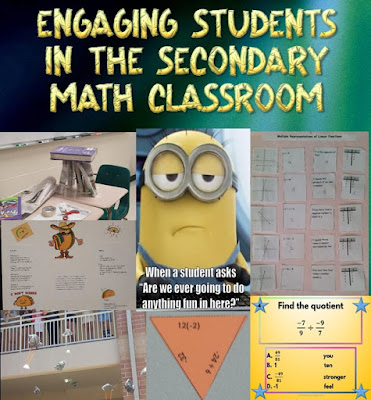
Creating an Engaging Secondary Math Classroom


We’ve all heard the saying “You’ll never get a second chance to make a great first impression”.  That’s one of the reasons teachers put so much time and effort into organizing, arranging, and decorating their classrooms.  We have a lot of people to impress – students, parents, coworkers, administrators, and we want to get it right.  Doing it over when you have not done it right in the first place?  Nobody’s got time for that, plus an opportunity wasted.  But even a really great first impression can’t save you in the day to day battle to teach math to teens and tweens.  To put that into perspective, use the movie Fifty First Dates as your variable with a coefficient of 3.6.   

https://www.teacherspayteachers.com/Store/Positively-Pre-algebra-Plus
 
In some ways, the daily challenge to engage students is much better than the first impression challenge.  If we mess up engaging students one day there is always the next.  The downside is that we always have to be on, we always have to be fresh, and we always have to be trying different things.  For engagement, it is the first five minutes of class that will make or break you.  If we fail to engage students at the beginning of class, we may never get them back.  Preparing classes and activities that actively engage students requires a lot of planning.  However, it is essential that we move students from passive learning (listening to the teacher, reading from a textbook, looking at slides) in order to increase their retention and understanding of the material. 

Here are some tips for designing engaging lessons that have worked for me:

1.   The 10-15 Rule.  Students have a short attention span.  By switching things up every ten to fifteen minutes, you have a better chance to keep and maintain their attention.  Break your lessons into small chunks that allow you to switch back and forth between you teaching and their doing.  Make sure each class contains opportunities for students to actively participate in their learning.

2.   Remember, the person doing the talking is the person doing the learning.  Yes, direct instruction is very much needed in mathematics, but give the kids a chance to talk too.  Let them paraphrase to a partner, create and solve a problem to exchange, have small group discussion and presentations, etc.  For review days consider having small groups give 5-7 minute “mini lessons” to the class.  Listening to my kids talk math is the highlight of each and every day. 

3.   Movement.  It’s hard to sit all day.  Think about how you feel during those endless faculty meetings and training sessions.  Use activities and resources that get kids out of their seats and moving.  It’s much harder for them to fall asleep or zone out when they are moving around.  Scavenger hunts, walk-abouts, relay games, and learning stations are all great options.

4.   Choice Menus.  Experiment with them for classwork, homework, and assessments.  Student Choice = Student Buy-in.  It’s a beautiful thing!

5.   Provide students with meaningful, relevant feedback.  We’re not talking grades here.  Students want to hear what we think about their work, ideas, and effort.  Try to provide specific, targeted feedback to students rather than the generic “good job”.

6.   Make it meaningful.  Math is all around us in the real world.  Show your students where it is and what it means.  Use technology like virtual field trips and webquests to help students see the connections to what they are learning and the world around them. 

As you transition to a more engaging classroom, remember you can’t do it overnight.  Set reasonable goals for yourself.  Maybe plan to include one activity per week or use choice menus once a month.  Try new things to find what works best for you and your students.  Get feedback from students to get an idea of what they like and don’t like.  Give yourself permission to fail.  There will be truly excellent experiences and truly horrible experiences when we move outside our comfort zones.  If you start each class in a way that sets a positive tone for learning, give students meaningful choices, set high expectations and teach our kids how to meet them, your classroom will become an engaging math community for you and your students.

Finally, I’d like to share some of my favorite words of wisdom for educators:


Happy teaching!

 https://www.teacherspayteachers.com/Store/Positively-Pre-algebra-Plus